Understanding Baby Priya's Law

A landmark change that brings empathy, fairness, and dignity to Australian workplaces.

Fair Work Amendment (Baby Priya’s) Act 2025 has come into effect

The lead-up to a birth is usually filled with excitement, anticipation and hope. Yet for some families, that joy turns to heartbreak when they experience the devastating loss of a baby through stillbirth or early infant death.

In Australia, around 2,000 babies are stillborn each year, and a further 600 die within the first month of life. For these families, the grief is profound — but until recently, the law didn’t always recognise the emotional reality of what comes next.

That’s where Baby Priya’s Law comes in.

What Is Baby Priya’s Law?

Baby Priya’s Law — officially known as the Fair Work Amendment (Baby Priya’s Law) Bill 2025 — was passed by the Australian Parliament in November 2025.

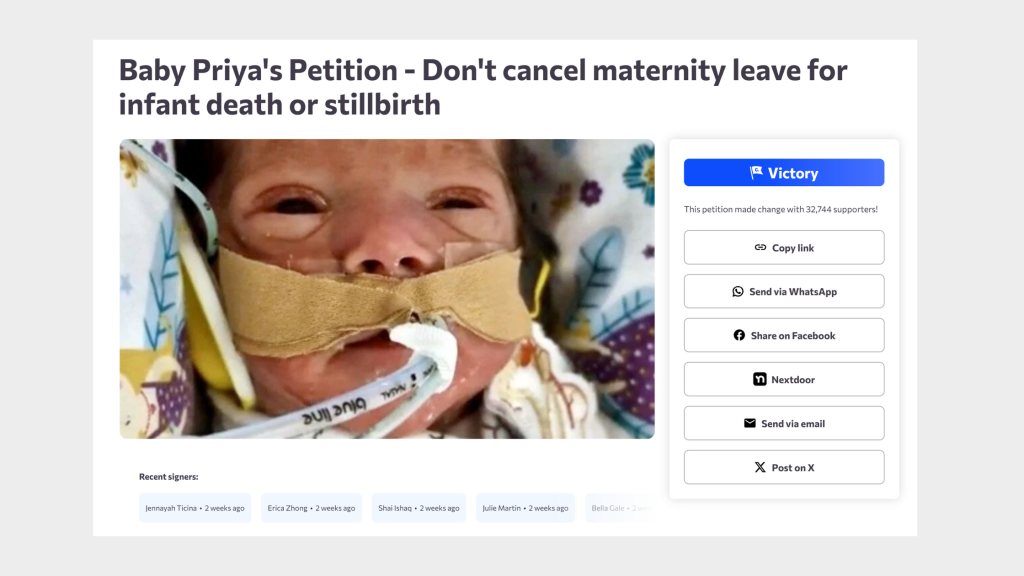
The legislation was named in memory of baby Priya, who sadly passed away at just 42 days old. Her parents’ experience exposed a painful gap in the law: while they were entitled to government-funded paid parental leave, their employer was able to cancel their employer-funded leave following their daughter’s death.

The new law ensures that no family in Australia has to go through that same experience.

"My daughter Priya was born prematurely at 24 weeks and 6 days. She passed away tragically six weeks after birth due to a condition unrelated to her prematurity. Five days later I informed the company I worked for, of my baby's passing. I had worked there for eleven years. They cancelled my maternity leave and informed me via text message soon after, giving me just one month of personal leave. I did not even get leave for the full six weeks my daughter was alive. Even when I asked if I could get at least 6 weeks leave, for the time she was alive, I was ignored with no response. "

What does the law change?

Prior to Baby Priya’s Law, employers could cancel or refuse paid parental leave if a child was stillborn or died — even if the employee had already been approved for leave.

Under the new amendments to the Fair Work Act 2009, employers can no longer do this, unless:

  • the employee requests that their leave end early, or

  • a prior agreement allows the employer to do so.

The change brings employer-funded paid parental leave into line with government-funded parental leave and unpaid parental leave arrangements, which already protected parents’ rights in these heartbreaking situations.

It’s important to note that Baby Priya’s Law doesn’t require all workplaces to offer paid parental leave — but it ensures that where this benefit does exist, families can rely on it, even in the event of loss.

Why this change matters

For any parent, losing a child is unimaginable. But for those also navigating workplace policies, financial strain and administrative hurdles, the grief can become even more overwhelming.

Baby Priya’s Law acknowledges the emotional and practical needs of bereaved parents. It recognises that grieving families deserve compassion, time, and financial certainty — not the added pressure of returning to work before they’re ready.

For families, it means being able to focus on healing and remembrance rather than paperwork or lost entitlements. For employers, it’s a reminder that compassion and understanding must guide workplace policy.

Information and events related to childloss

About Remembering Our Angels

Our Remembering our Angels services help families to remember a child or infant they have lost, meet other families who have experienced similar circumstances, and provides an opportunity to create new memories around their loved one.

Read More »

A Step Toward Compassion in Employment Law

The introduction of Baby Priya’s Law is part of a broader cultural shift in Australia’s approach to grief, mental health and workplace wellbeing.

Over the past decade, there has been growing recognition that grief doesn’t fit neatly into workplace leave categories. The law now reflects a more human understanding — that parents who lose a child still need and deserve the same time, space and support as those caring for a newborn.

The passage of the bill also highlights the power of advocacy. Baby Priya’s parents bravely shared their story to help create change, turning their personal tragedy into a lasting legacy for other families.

What Employers Should Know

For workplaces, Baby Priya’s Law is a call to review and update policies. Employers should:

  • Ensure that paid parental leave policies align with the new legal protections.

  • Communicate clearly with employees about their entitlements.

  • Offer sensitivity training for managers and HR staff to better support employees experiencing loss.

  • Create a culture where bereaved employees feel safe to take the time they need — without fear or guilt.

Even beyond compliance, this is an opportunity for organisations to demonstrate empathy and leadership. Compassionate policies not only support individuals through grief but also build stronger, more trusting workplaces.

It is best for both employers and employees to seek information and advice through the Fairwork Ombudsman or legal counsel.

Honouring Baby Priya's Legacy

While no legislation can ease the pain of losing a child, Baby Priya’s Law ensures that such loss is met with understanding, not bureaucracy. It affirms the importance of treating grief with dignity and care — values that resonate deeply with the work we do every day at Tobin Brothers Funerals.

This law is a reminder that compassion can shape systems, not just sentiment. It stands as a lasting legacy for baby Priya and a promise of gentler treatment for the families who walk this difficult path in the future.

Final thoughts

If you or someone you know has experienced the loss of a baby, please know that support is available.

Organisations such as Red Nose Australia, Bears of Hope, and Stillbirth Foundation Australia provide free counselling and community support for grieving parents and families.

At Tobin Brothers Funerals, we believe that every story — no matter how short — deserves to be remembered. If you’d like more support, please see our support and resources section at tobinbrothers.com.au/support-and-resources


Picture of Tobin Brothers Funerals

Tobin Brothers Funerals

Celebrating Lives Since 1934

Looking for Support?

See our Support and Resources for information and resources.
Scroll to Top

Search

Search

Founded in 1934

The first funeral conducted by Tobin Brothers Funerals was for Ena Margaret Price in 1934. In its first year, the company conducted 53 funerals and after the payment of creditors and the collection of debts, it made a modest profit.