Celebrating Culture: Japanese Kotsuage Ceremony

A recent trip inspired Tobin Brothers Funeral Director and branch manager Tom Buttigieg to explore Japan’s unique approach to death.

Japanese Kotsuage Ceremony 骨上げ

Japan is a land steeped in tradition, from tea ceremonies and temple worship to the everyday expressions of gratitude shown in preparing meals or providing services. These customs permeate life, large and small, with quiet reverence and ritual.

Having experienced many of these cultural practices on my recent trip to Japan this past June, I developed a sincere interest in witnessing a traditional cremation, particularly the Japanese Kotsuage ceremony, the ritual of collecting the bones after cremation.

With the help of some international funeral industry contacts at Funeral Support Services (FSS), a repatriation service working in Japan to assist with repatriations out of Asia, I was graciously given the opportunity to attend such a ceremony.

Arriving to witness the Kotsuage Ceremony in Kawasaki, just outside of Tokyo.

Arriving at the Ceremony

Out of respect for the family involved, I will omit personal details of the deceased and their loved ones. I will only say that they were exceptionally kind and welcoming, as I made every effort to ease my conspicuous presence (as inconspicuous as I can be).

The ceremony took place at a public crematorium in Kawasaki, just outside Tokyo. The facility, a minimalist four-story building nestled on a bustling street, offered a striking contrast between its external simplicity and the quiet elegance within. I waited in the foyer on the first floor, looking out through floor-to-ceiling windows onto a peaceful water feature in the circular driveway courtyard.


Japanese Kotsuage blog
Other elements often found in Japanese funeral ceremonies include, Hitsugi (Coffin), Kouro (Censer/Burner), incense stick, Candle, Rin (Standing bell, Buddhistic bell), Rinbo (Striker).

The Procession

The casket arrived by hearse, and sharply dressed crematorium staff assisted funeral directors in unloading it by hand onto a motorised trolley. Japanese caskets tend to be rectangular – typically plain, occasionally ornate, with simple textile veneers, no handles, and a small viewing window at the head.

As the casket was processed into the building, the family followed in a solemn procession. We entered a modest sized lobby – all sandstone, marble, and earthy-toned wood, five stone statue pillars lined the welcoming wall understated in their design but giving conscious thought to a motif of transition or change.

The casket was taken to a viewing room, where a photo of the deceased was placed on a small altar, accompanied by three sand-filled incense burners. This was the final moment for quiet reflection before cremation, often following an earlier funeral or prayer service at a temple or funeral home.

Kotsuage 4 Family Waiting Area
The family waiting area.

The Cremation Chambers and Ceremony

After this farewell, the casket was moved to the cremation chambers. This area housed twelve chambers lined in a row, each behind etched, dark stone doors. The stonework was again ornate, and the atmosphere dignified. Once the casket was placed in the chamber and the doors silently closed, all present bowed deeply. The family was given a numbered card and guided to a lounge area upstairs, where they could wait and take refreshments during the cremation.

When the process was complete, we were called back downstairs. The chamber was opened with reverence, and we bowed once again. Inside lay the remains: white, brittle bone fragments – still recognisable in form, but broken and delicate. A staff member respectfully explained the bone structure to the family, pointing out the different segments and preparing them for what would come next: the Kotsuage ceremony.

The cremation chambers

The Kotsuage Ceremony

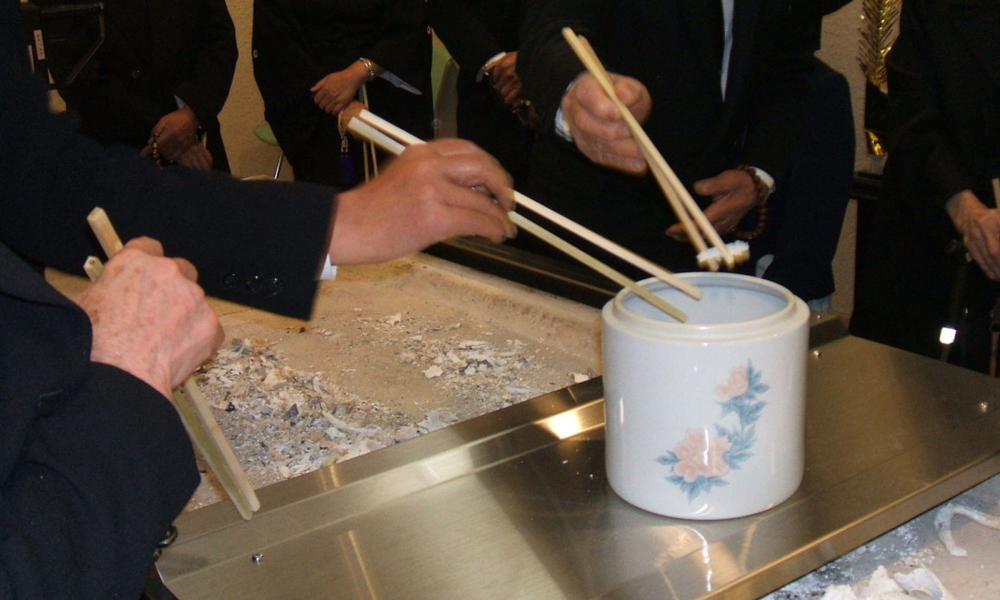
In a private room, the crematorium staff brought the remains on a tray for the family to place into the urn. This ritual begins with the larger bones of the lower body, and continues upward. Family members use two different types of long chopsticks – one made of bamboo, the other willow – symbolising the two realms of existence: life and the afterlife. Working in pairs, they gently lift each bone and place it into the urn, moving upward through the body to ensure the remains are upright.

The final and most symbolic moment comes when the second cervical vertebra, often called the “nodobotoke” or “bone Buddha,” is placed at the top. This bone, said to resemble a seated monk in prayer, holds special spiritual significance. Once all the remains are transferred, the urn is closed, wrapped in white linen, and placed into a simple pine box, which is then covered in white silk.

The family, crematorium staff, and all those present bowed once more, expressing gratitude and respect. Despite the crematorium’s high activity, the atmosphere remained calm, composed, and compassionate. Families passed each other quietly, some holding photographs, prayer talismans, or small floral offerings. The environment was far from clinical and procedural.

Kotsuage 骨上げ, is also known as "bone-picking".

A Deliberate Grace

As I sat quietly in the waiting area afterward, I found myself reflecting on the deliberate grace with which every step of the ceremony had been handled – from the careful choreography of movement to the subtle but profound use of symbolism. There was no rush, no clinical detachment. Every motion felt sacred. It was clear that this wasn’t simply a technical process of cremation, but a deeply human act of transition – from life to memory, from body to spirit.

What struck me most was the physical involvement of the family in handling the remains – something rarely seen in Western traditions, where the deceased is often kept at a distance. Here, through the Kotsuage ceremony, family members engage directly with the body, participating in the final stages of care. It’s both intimate and unflinching.

Final Thoughts

In the days that followed, what lingered most was how presence defines the Japanese approach to death. Not presence in the abstract, spiritual sense – though that too is important – but presence as in being there, fully. Watching, holding, lifting. The ceremony doesn’t allow for distance or euphemism. The bones are not hidden. They are recognised, respected, and returned to family hands.

Here, the body – the very material of memory – is given back to the family in a literal sense. They carry the weight of loss in their hands, not only in their hearts.

As someone from outside this tradition, I cannot claim full understanding of the layers of meaning this ritual holds for Japanese families. But I can say this: to be invited into such a sacred moment was a profound honour – one that I will carry with me not only as a memory, but as a quiet shift in how I understand life, death, and the spaces between. Particular how we each uniquely celebrate life.

Picture of Tom Buttigieg

Tom Buttigieg

A fourth generation Tobin family member, Tom is a passionate and dedicated Funeral Director at Tobin Brothers. Branch Manager of both Malvern and Ashburton, Tom is praised by families for his expertise, professionalism and calming presence.

Quick Links

For more information about how Tobin Brothers can help you honour culture and tradition through funeral ritual and ceremony, see our Cultural Services page.

Find out more about the tradition of Japanese Kotsuage or see the Smart Traveller website for more information about what happens if you die overseas.

For more specific information and assistance in the event of someone dying in Japan, the Australian Embassy in Tokyo has up to date guidance for Australians. 

Picture of Tobin Brothers Funerals

Tobin Brothers Funerals

Celebrating Lives Since 1934

Looking for Support?

See our Support and Resources for information and resources.
Scroll to Top

Search

Search

Founded in 1934

The first funeral conducted by Tobin Brothers Funerals was for Ena Margaret Price in 1934. In its first year, the company conducted 53 funerals and after the payment of creditors and the collection of debts, it made a modest profit.