Coping with Grief

Grief is a universal human experience, yet it’s one of the most complex and challenging emotions to navigate. Dealing with Grief is never easy for anyone, but at Tobin Brothers, as we deal with it more often then most, we will do our best to demystify it for you.
At Tobin Brothers Funerals, we understand grief carries with it a myriad of emotions, some of which can be confusing, troublesome, and hard to manage. As such, we’ve taken care to provide an assortment of resources designed to help you cope during this trying time.
Dealing with Grief
Regardless of the type of loss, whether it’s the loss of a loved one, the end of a relationship, or a major life transition, grief can manifest in myriad ways, affecting every aspect of our lives.
At Tobin Brothers Funerals, our work sees us at the frontlines of grief each and every day. We see the pain of loss when we meet with families, and have witnessed the vast spectrum of emotion that can accompany the death of a loved one.
This is why we endeavour to assist families with a funeral service that aids them in their grief journey. Additionally, we aim to give families a greater level of care by providing information and support beyond the funeral service.

Understanding Grief
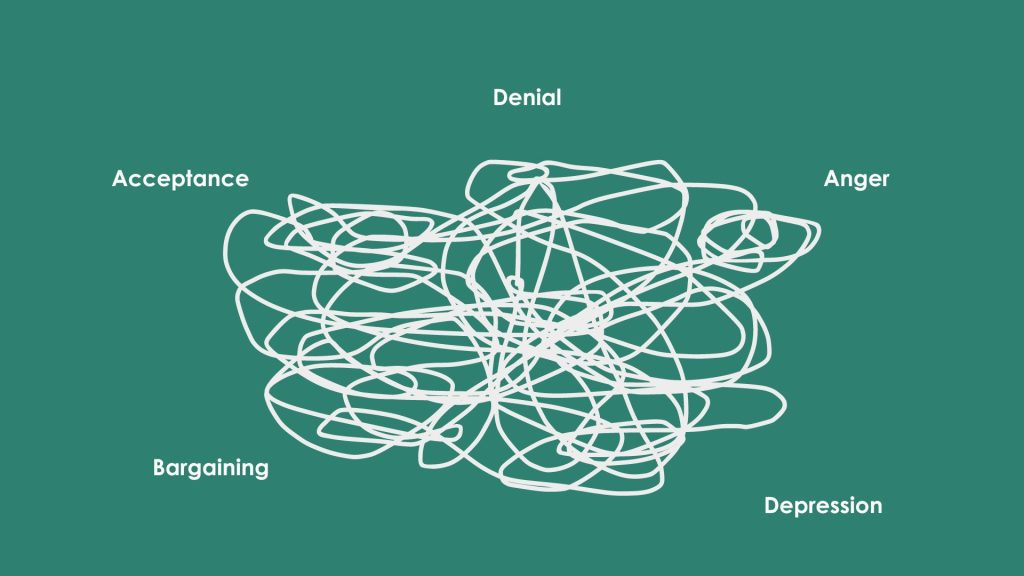
Grief is not a linear process with neat stages. In contrast it is messy, nonlinear, and deeply personal.
While the Kübler-Ross model popularised the idea of stages of grief (denial, anger, bargaining, depression, acceptance), it’s important to recognize that grief doesn’t follow a predetermined path.
People may experience these stages in different orders, multiple times, or not at all.
The Impacts of Grief
Grief affects us in every realm: physically, emotionally, mentally, and spiritually.
Physically, it can manifest as fatigue, headaches, or changes in appetite.
Emotionally, it can lead to intense sadness, anger, guilt, or even numbness.
Mentally, grief can impair concentration and decision-making abilities.
Spiritually, it may prompt existential questions and a search for meaning.
It may manifest in all of these ways for some, and in only one particular area for another. Many people are surprised just how varying and often-times intense the physical aspects of grief can be, and how all-encompassing its effects can be in all areas of their lives.

Coping Strategies for Dealing with Grief
Allow Yourself to Feel:
It’s okay to feel a range of emotions, even if they seem contradictory. Allow yourself to experience them without judgement or self-censorship.
Seek Support:
Surround yourself with supportive friends, family members, or a therapist who can provide a safe space for you to express your feelings.
Self-Care:
Take care of your physical and emotional well-being. This may include exercise, healthy eating, adequate sleep, and engaging in activities you enjoy.
Express Yourself:
Find creative outlets to express your emotions, whether it’s through writing, art, music, or dance. Expressing your feelings can be cathartic and healing.
Practice Mindfulness:
Mindfulness techniques such as meditation, deep breathing, or yoga can help you stay grounded and present during difficult moments.
The Journey of Healing
Healing from grief is not about “getting over” the loss but learning to live with it. It’s about finding meaning and purpose in life despite the pain.
Healing from grief is not a destination but a journey, and like any journey, it unfolds gradually, with its own twists and turns. At times, it may feel like taking one step forward and two steps back, but every step, no matter how small, is a testament to your resilience and strength.

Accepting Grief
Grief is a natural response to loss, and it’s important to honour our emotions and give ourselves permission to grieve.
By understanding the complexities of grief and implementing healthy coping strategies, we can navigate this journey with greater resilience and compassion for ourselves and others.
Remember, you are not alone in your grief, and there is hope for healing and growth on the other side.
Grieving any kind of loss
Grief is the very natural response to a significant loss in our life. Grief takes time, and the length of time is different for everyone as they move through the process.
The loss which most often causes intense emotional pain and many other different responses, is death. There is no easy way to lose someone you love and often the cause of the death brings with it its own complexities, an example of this is when death occurs through suicide. Our blog about Surviving Suicide gently outlines some helpful ways to cope with this devastating event.
Sometimes, in life, we experience losses which are not recognised publicly and therefore we do not receive the support we need. The information listed on our web page Grief Can Come in Many Forms and at Many Times acknowledges this fact, and offers insights into what an individual may be dealing with privately.
Perhaps when we are grieving we find ourselves behaving in ways which surprise us and/or others. There is no ‘right’ or ‘wrong’ way to grieve. There are many reasons which influence our responses.
See our brochures page for more support materials that may assist in understanding your own feelings and/or those of family members and friends.
Download our Guides to Grief
From taking a look at the process of bereavement itself, and how you can use the pain of grief to honour, reflect on, love and honour what was, to how to help children cope with grief, we offer some helpful tips and insight into death, the grieving process, and the variety of support services that are available to you as you navigate your loss.
Children in Grief
Another significant factor which influences our responses is our age at the time of the loss.
Children develop over a period of years in their ability to grasp concepts such as time and the permanency of death. Our brochure Children in Grief offers a concise overview of this development of understanding which will assist parents, teachers, caregivers and others who support grieving children.
Join our Community of Support
We recognise that losing a loved one can be a life-changing experience, and we invite you to contact us following the funeral, if you feel we can help in any way.
For 24 hour service and enquiries, contact us at info@tobinbrothers.com.au or telephone 13 19 34
We also welcome you to join our online community via Facebook or Instagram, and note that we have various After Care Events that are held annually for bereaved families and friends.

Tobin Brothers Funerals
Celebrating Lives Since 1934